

France's national cybersecurity agency, ANSSI, handled 1,366 incidents in 2025, according to its annual threat panorama published on 11 March 2026. Data-exfiltration incidents rose from 130 to 196 in a year. At the same time, the bill that brings NIS2 into French law is still going through Parliament, and ANSSI expects several thousand entities in 18 sectors to fall under it.
A test d'intrusion (penetration test) is a practical way to show that security measures work. This guide compares seven penetration testing companies for French buyers, explains when you need a PASSI-qualified provider, and shows what a pentest costs. We build one of the seven, AISafe Labs. We're a Romanian company that serves many customers in France, so we list ourselves first and say plainly where a French firm is the better choice.
This comparison was published on November 27, 2026 and reflects the tools as we tested them then. Pricing and features change often, so check each vendor’s current pages for the latest.
Summary
- Who this guide is for: RSSIs, CISOs, CTOs, compliance leads and founders in France who need a pentest for NIS2 preparation, DORA, a customer, an audit or a tender.
- What the rules ask: the NIS2 bill isn't law yet. DORA has applied to financial entities since January 2025, and GDPR asks every organisation to test its security measures regularly. When a buyer or regulator wants a qualified auditor, that often means an ANSSI PASSI provider.
Penetration testing companies in France compared
| Company | Based in | Pentest focus | Public credentials | Best for |
|---|---|---|---|---|
 | Romania (serves customers across France) | AI pentests of web apps and APIs, white-box pentests, code audits | No national accreditation; EU data residency; reports mapped to ISO 27001, SOC 2, PCI DSS and OWASP ASVS | Software teams that want fast, repeatable application testing |
| Intrinsec | Courbevoie | External, internal, application, mobile, IoT, cloud and Entra pentests | PASSI Élevé, all five scopes; PRIS | Public bodies and national-security work |
| Lexfo | Paris | Black-, grey- and white-box pentests, red team, ICS/IoT, M&A due diligence | PASSI Élevé, all five scopes | Technical audits and acquisitions |
| Orange Cyberdefense | Nanterre | Pentest, red and purple team, IoT/OT/cloud, code audit, DORA TLPT | PASSI Élevé, all five scopes; PRIS and PDIS | Large organisations wanting pentests plus SOC and CERT |
| Synacktiv | Paris | Network, web, mobile, CI/CD, cloud, IoT/OT pentests; TIBER and DORA red team | PASSI Élevé, all five scopes | Deeply technical targets |
| Vaadata | Lyon | Web, mobile, LLM, cloud, infrastructure, IoT pentests; social engineering; red team | PASSI Substantiel (penetration tests) | SaaS, start-ups and SMBs |
| XMCO | Paris | Entra, CI/CD, API, mobile, SAP, Citrix and mainframe pentests; red team | PASSI Élevé, all five scopes; PCI QSA | Mixed legacy and cloud estates, PCI scope |
1. AISafe Labs
- Who it's for: French SaaS publishers, fintechs, e-commerce sites and software teams that need web application and API pentests for enterprise customers, NIS2 preparation, DORA evidence or ISO 27001, and want them at the pace they ship.
- Who it isn't for: Organisations whose audit must come from a PASSI-qualified provider, financial entities running TIBER-FR or DORA TLPT, and teams that need network, OT, physical or red team engagements.
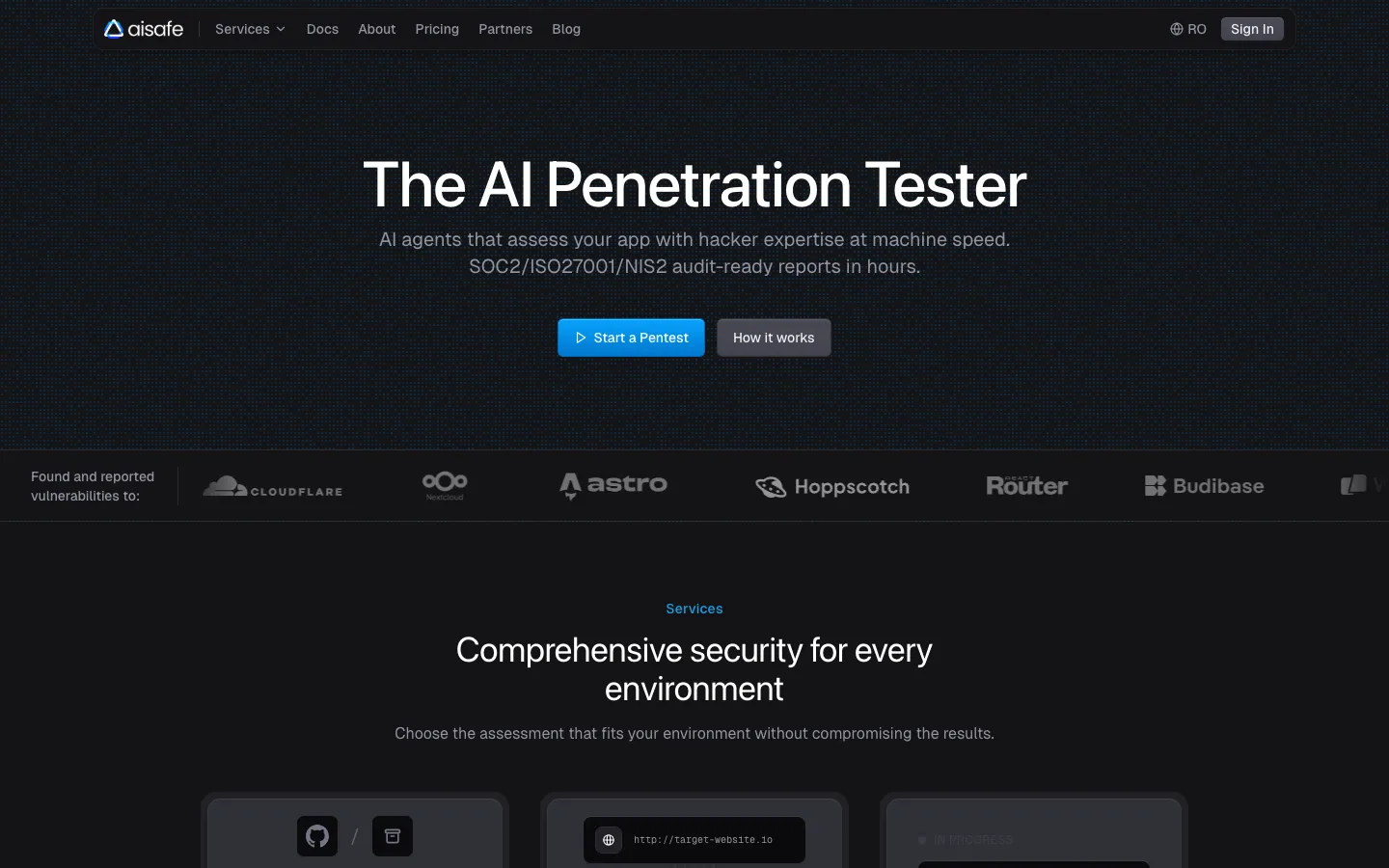
What is AISafe Labs?
AISafe Labs is an AI penetration testing company founded in 2025 in Timișoara, Romania, by a team of security researchers. It serves many customers in France and runs every engagement remotely through its platform.
Its AI agents work like a good attacker. They log in with your test accounts, go through every screen and API call, work out which user may do what, and try to break those rules. A second agent checks every candidate before it reaches you, so the report holds proven vulnerabilities only. Where a traditional engagement needs weeks of scheduling, AISafe Labs delivers in hours.
What AISafe Labs tests
- Web application pentests: the live application over HTTP and in a real browser, logged out and as each user role.
- API pentests: REST and JSON endpoints, including the APIs behind your mobile apps.
- White-box pentests: agents read the source code to find likely weaknesses, then confirm each one against the running application. Every finding shows the vulnerable code path and the request that proves it.
- Code audits: a review of the whole repository that traces user input to sensitive operations, with a record of every check performed.
- Pull request review: security comments on GitHub and GitLab pull requests, so new flaws don't reach production.
- Endpoint monitoring: re-runs the proof of each fixed finding on a schedule and tells you when a fix regresses.
The agents look for injection (SQL, command, template and cross-site scripting), server-side request forgery, broken access control and IDOR, authentication bypass, information disclosure and business logic flaws such as price manipulation and race conditions. Automated scanners seldom find those access-control and logic flaws.
How an AISafe Labs pentest works
- Signing in. The agents sign in as each test user you add. The test can reach only your targets and the domains you allow.
- Mapping the application. They explore every target, signed out and as each role, and record its pages, API calls, roles and data flows.
- Modelling threats. They list the threats your application faces and turn them into a checklist of security questions.
- Testing. Each question is tested against your app, and every result is checked against the traffic that was actually sent.
- Triage. A separate agent confirms or rejects each candidate and merges duplicates.
- Report. You get the confirmed findings, their evidence, the tests that ran and remediation guidance.
What's in the report
Each finding comes with the captured request and response, a proof-of-concept script that was run against your system before publication, ordered reproduction steps naming the test user for each step, an impact assessment and a suggested fix. The PDF report can be shared by link with an auditor or customer who has no account.
AISafe Labs maps every finding to ISO/IEC 27001:2022, SOC 2, PCI DSS v4.0.1 and OWASP ASVS, which helps a French company going through ISO 27001 certification or a large customer's audit. It's evidence, not a certification.
AISafe Labs and French requirements
- PASSI: AISafe Labs isn't PASSI-qualified. When a regulator, a public buyer or a contract asks for a qualified audit provider, use a PASSI firm for that audit and AISafe Labs to keep testing your applications between audits.
- NIS2: the French law isn't adopted yet, but the entities it will cover can start now. Regular application testing with dated evidence supports the risk-management measures NIS2 asks for.
- DORA: findings and retests give banks, insurers and investment firms a record of ongoing application testing. TIBER-FR and DORA threat-led penetration testing are separate exercises.
- GDPR Article 32: it asks for regular testing of the effectiveness of your security measures, and each AISafe Labs report is dated evidence of that testing.
Data protection and EU hosting
AISafe Labs processes your data in European Union regions, encrypts it in transit and at rest, and deletes it when your retention period ends. The agents run in isolated sandboxes that can reach only your targets. Your code, findings and data are never used to train AI models, and a data processing agreement is available on request.
How much does AISafe Labs cost?
AISafe Labs publishes its plan prices on its pricing page. Basic is free and includes SAST, AI SAST, dependency, secrets, licence and IaC scanning. Pro starts at $40 a month and includes the same amount in credits for pentests, code audits and monitoring. The exact price of each test is shown before it starts.
Bottom line
For web applications and APIs, AISafe Labs gives French teams pentest results in hours, proof for every finding and a price known in advance. For a PASSI audit, TLPT, networks or OT, pair it with one of the qualified firms below.
2. Intrinsec
- Based in: Courbevoie
- Best for: public bodies and operators doing national-security work
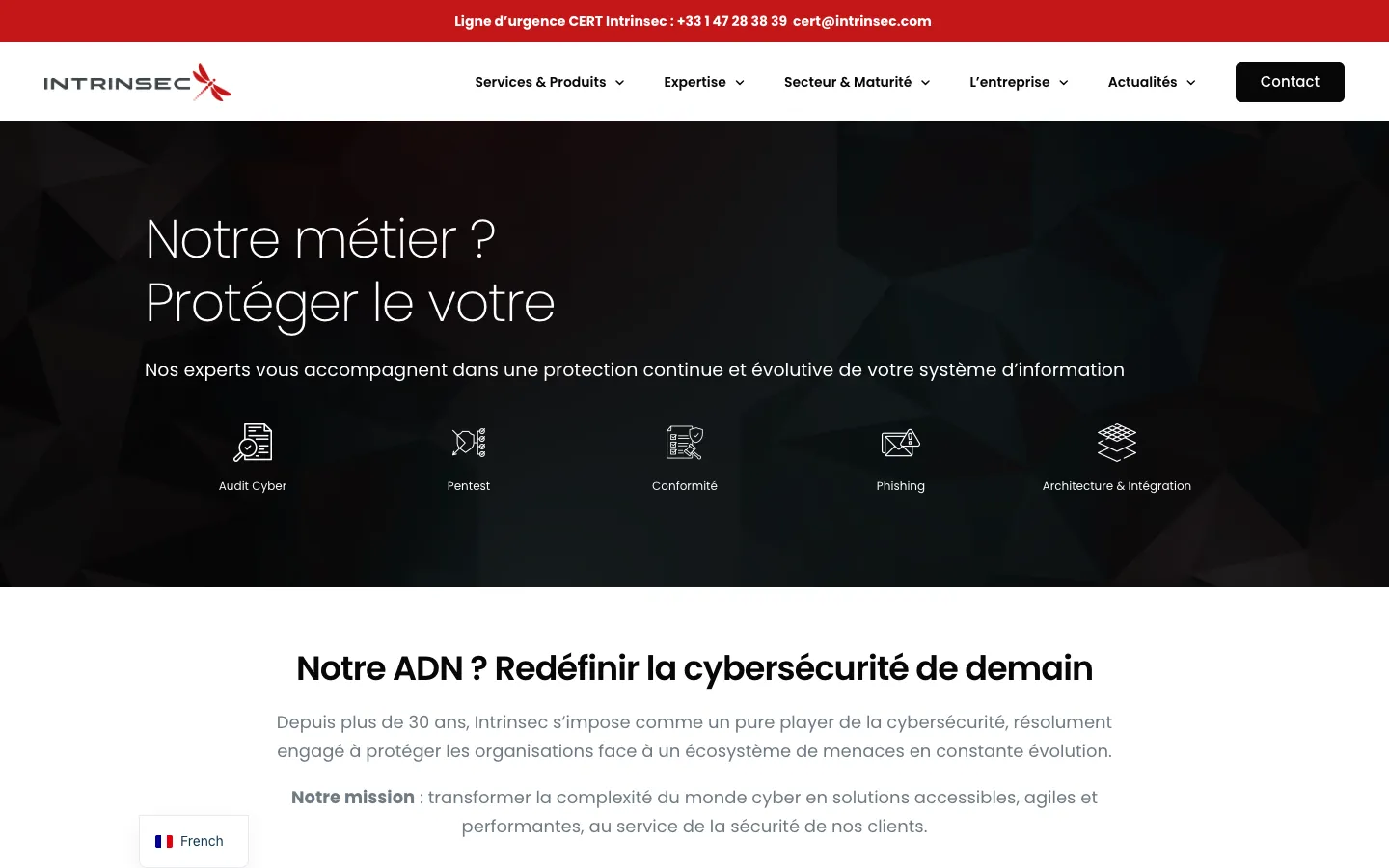
Intrinsec Sécurité SAS says it has more than 30 years of experience and ran one of the first French penetration tests in 1995. It tests external and internal perimeters, applications, mobile apps, IoT, and cloud and Entra environments. It's PASSI-qualified at the Élevé level for all five scopes and also holds the PRIS qualification for incident response. The company has about 250 employees.
Bottom line: a long-established qualified provider for sensitive public-sector work.
3. Lexfo
- Based in: Paris
- Best for: technical audits and security due diligence during acquisitions
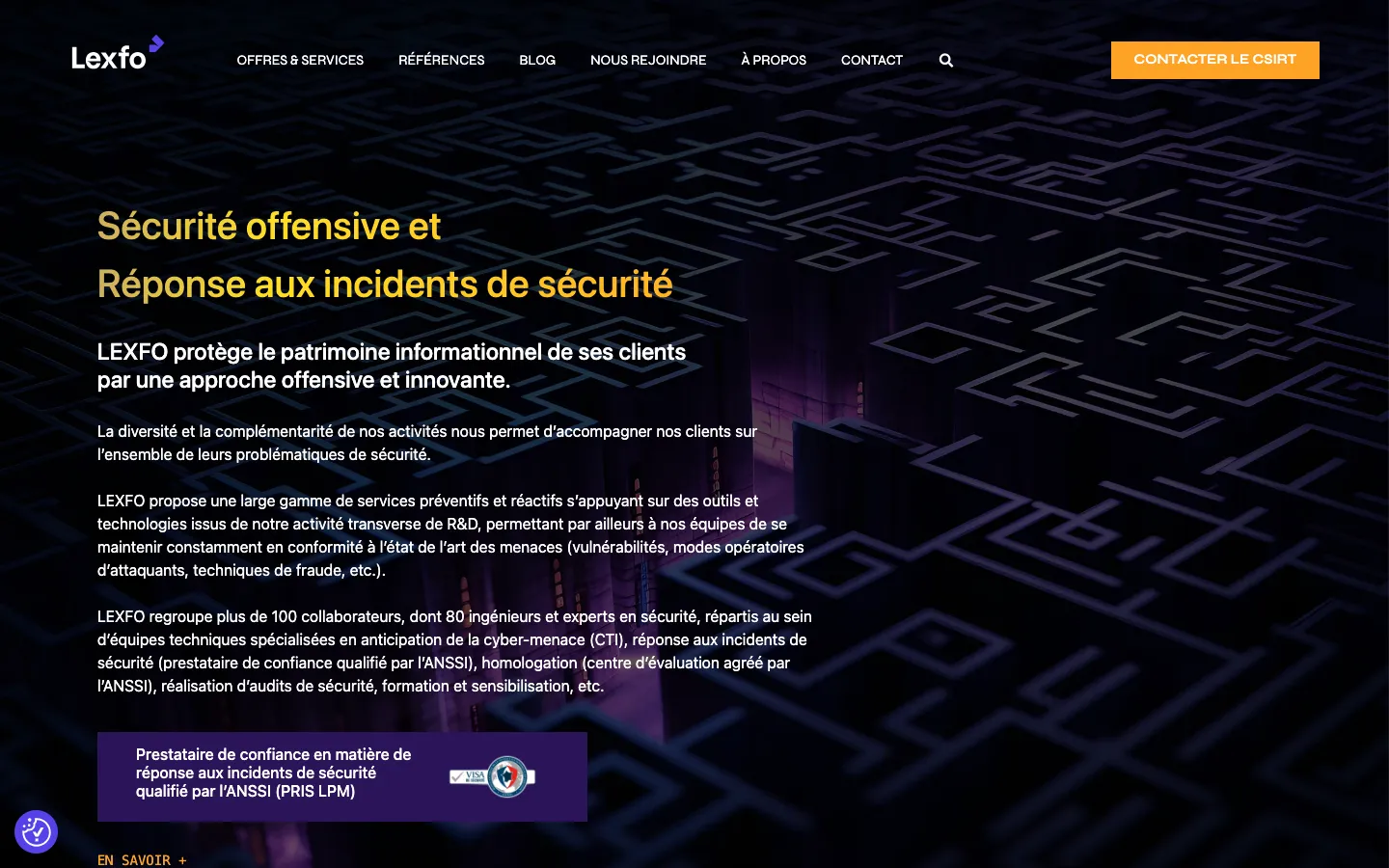
Lexfo SAS runs black-, grey- and white-box penetration tests, red team engagements, ICS and IoT assessments, and security due diligence for mergers and acquisitions. It's PASSI-qualified at the Élevé level for all five scopes. Lexfo says it delivers more than 2,000 projects a year with a team of over 80 engineers.
Bottom line: a strong technical firm that also covers security due diligence for acquisitions.
4. Orange Cyberdefense
- Based in: Nanterre
- Best for: large organisations that want pentests alongside a SOC and CERT

Orange Cyberdefense France SAS has teams in eight French cities. It offers penetration tests, red and purple teaming, IoT, OT and cloud testing, code audits and DORA threat-led testing. It's PASSI-qualified at the Élevé level for all five scopes and also holds the PRIS (incident response) and PDIS (detection) qualifications. It runs about 700 missions a year in France with 90 pentesters.
Bottom line: the natural choice if you want testing, detection and response from one large provider.
5. Synacktiv
- Based in: Paris, with offices in Toulouse, Lyon, Rennes, Lille and Bordeaux
- Best for: deeply technical targets
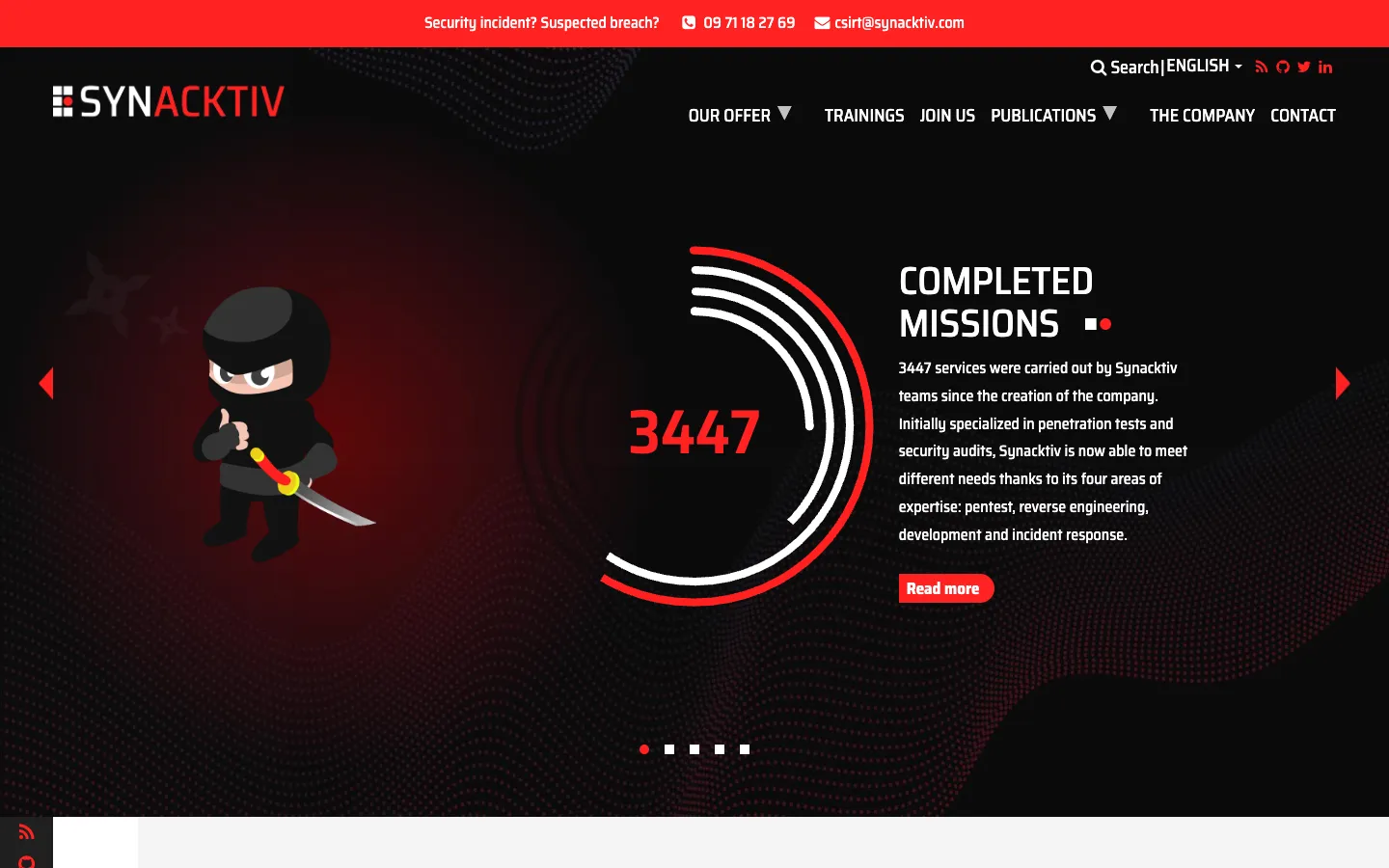
Synacktiv SAS runs network, web, mobile, CI/CD, cloud, IoT and OT penetration tests, and TIBER and DORA red team engagements. It's PASSI-qualified at the Élevé level for all five scopes. Its homepage counts 3,447 missions since the company was founded.
Bottom line: a choice for complex or unusual targets for complex or unusual targets.
6. Vaadata
- Based in: Lyon
- Best for: SaaS companies, start-ups and SMBs
Vaadata SARL tests web and mobile applications, LLM features, cloud, infrastructure and IoT, and runs social engineering and red team engagements. It's PASSI-qualified at the Substantiel level for the penetration testing scope, and its site also cites ISO 27001 and CREST. Vaadata says it has worked for more than 800 client organisations.
Bottom line: an accessible French firm for growing software companies.
7. XMCO
- Based in: Paris, with offices in Nantes and Labège
- Best for: large estates that mix legacy and cloud systems, and PCI DSS scope
XMCO SAS tests Entra ID, CI/CD pipelines, APIs, mobile apps, SAP, Citrix and mainframes, and runs red team and PCI DSS work. It's PASSI-qualified at the Élevé level for all five scopes and is a PCI Qualified Security Assessor. It carries out about 700 audit missions a year and runs its own CERT, CERT-XMCO.
Bottom line: a good fit for enterprises with old and new systems side by side.
How to choose a penetration testing company in France
| Check | Why it matters |
|---|---|
| PASSI qualification | If a regulator, public buyer or contract asks for a qualified provider, check the firm, its level (Élevé or Substantiel) and its scopes in the ANSSI catalogue. |
| Scope | List every web app, API, network range and cloud account, and every user role. Anything left out of scope isn't tested. |
| Proof of exploitation | Ask for a sample report. Each finding should include the request, the response and the steps to reproduce it. |
| Retesting | Ask whether a retest is included, how long you have to fix, and what it costs. |
| Frequency | A yearly audit leaves months untested after each release. On-demand or continuous testing closes that gap. |
| Data handling | Ask where test data is stored, who can see it and when it's deleted. |
| Report language | Confirm with each provider whether the report comes in French or English, and which your auditors need. |
French rules that drive penetration testing
NIS2. France hasn't finished transposing NIS2. The bill on the resilience of critical infrastructure and the strengthening of cybersecurity was adopted by the Senate at first reading on 12 March 2025. The Assemblée nationale adopted an amended text on 17 November 2026, and the bill went back to the Senate on 24 November 2026. ANSSI's NIS2 portal says that transposition is in progress and that several thousand entities in 18 sectors are concerned.
PASSI. ANSSI qualifies security audit providers under PASSI. The qualification has five scopes (organisational and physical, architecture, configuration, source code and penetration tests) and two levels, Élevé and Substantiel. The official list sits in the ANSSI catalogue, last updated on 24 November 2026.
DORA and TIBER-FR. DORA has applied to financial entities since January 2025. The Banque de France and the ACPR jointly run TIBER-FR, with guidance for DORA threat-led penetration testing.
GDPR. Article 32 security duties apply to every controller and processor, including regular testing of security measures. The regulator is the CNIL.
How much does a penetration test cost in France?
Most French firms on this list don't publish prices, so you'll need a quote. One exception is Vaadata: a Vaadata blog post puts a typical pentest at €3,000 to €20,000, and a first pentest at €1,500 to €5,000. These factors set the price:
- Scope: the number of applications, APIs, roles, IP ranges and cloud accounts.
- Depth: a black-box test costs less than a grey- or white-box test with credentials and source code.
- Type: a web app test d'intrusion costs far less than a red team or a TIBER-FR exercise.
- Qualification: asking for a PASSI provider, and for the Élevé level, narrows the choice.
AISafe Labs publishes its pricing: the Basic plan is free, Pro starts at $40 a month with the same amount in credits, and the price of each pentest is shown before it starts. At that price, testing every release becomes realistic.
When to choose AISafe Labs and when to choose a local firm
- Choose AISafe Labs for web applications and APIs, when you ship often, when a customer or auditor wants a recent test, or when you want results in hours at a known price.
- Choose a PASSI-qualified firm when a regulator, a public buyer or a contract asks for a qualified audit provider.
- Choose a specialist for internal networks, Active Directory, SAP or mainframes, OT, TIBER-FR or red teaming.
- Use both for the strongest position: a PASSI firm for the formal audit, and AISafe Labs to keep every application tested between audits.
Is AISafe Labs right for you?
A yearly audit checks your applications at one moment, but they change every week. AISafe Labs keeps them tested:
- Results in hours. AI agents pentest your app and deliver a report with proof for every finding.
- Deeper coverage. White-box testing and code audits find the access-control and logic flaws scanners miss.
- Evidence for your audit. Findings map to ISO 27001, SOC 2, PCI DSS and OWASP ASVS controls.
- EU data residency. Your data is processed in the EU and never used to train AI models.
Start for free and see the price of your first pentest before it runs. For more options, see the best pentesting tools and the best European security platforms.
FAQ
For web applications and APIs, AISafe Labs gives fast results at a published price. For PASSI-qualified audits, Synacktiv, Intrinsec, Lexfo, Orange Cyberdefense and XMCO are qualified at the Élevé level for all five scopes. Vaadata suits SaaS companies and SMBs that want a qualified French firm.
No general law orders every company to run a test d'intrusion. GDPR asks for regular testing of your security measures, and DORA requires financial entities to test their resilience. The NIS2 bill, once adopted, will add risk-management duties for several thousand entities. Customers and tenders often ask for a recent pentest too.
Most French firms quote each test by scope, depth and type. A Vaadata blog post gives a typical range of €3,000 to €20,000, and €1,500 to €5,000 for a first pentest. AISafe Labs publishes its pricing: Basic is free, Pro starts at $40 a month with the same amount in credits, and each pentest's price is shown before it runs.
Yes, for most tests. A company in another EU country, such as AISafe Labs in Romania, can test your applications remotely under GDPR. The exception is an audit that must come from a PASSI-qualified provider. AISafe Labs isn't on ANSSI's list, so use a qualified firm for that audit.
A PASSI provider is a security audit firm qualified by ANSSI. The qualification covers up to five scopes, including penetration tests and source code audits, at the Élevé or Substantiel level. You need one when a regulator, public buyer or contract asks for a qualified audit. Check the firm's level and scopes in the ANSSI catalogue.
Not yet. The transposition bill passed the Assemblée nationale on 17 November 2026 and went back to the Senate on 24 November 2026. ANSSI says several thousand entities in 18 sectors will be concerned.
